New strategy. New hires. Same wall.
Sales dip. Good people leave. The launch stalls. Every fix buys a quarter — then the company hits the same ceiling again. This page will show you where the wall actually is.
Read this — see if it reads you ↓SEDONA, ARIZONA
Let me tell you about the last off-site.
New strategy on the whiteboard. Real energy in the room. You drove home thinking: this is the one.
It bought you a quarter.
Then the numbers flattened, the same conversations came back, and the company stood at the same wall — wearing a new coat of paint.
And late one night, looking at the dashboard, a thought you’d never say in a board meeting:
“why does every problem eventually look the same?”
Good question. Better than you know.
If that’s your last few years on repeat — keep reading.
This page was written for you. And it’s going to get uncomfortably specific.
The company keeps hitting the same wall.
So do you.
You’ve done what good operators do. Here’s the receipt.
Every one of those works for other companies. None of them held here. Sit with the strangeness of that for a second — because it’s the most important clue you have.
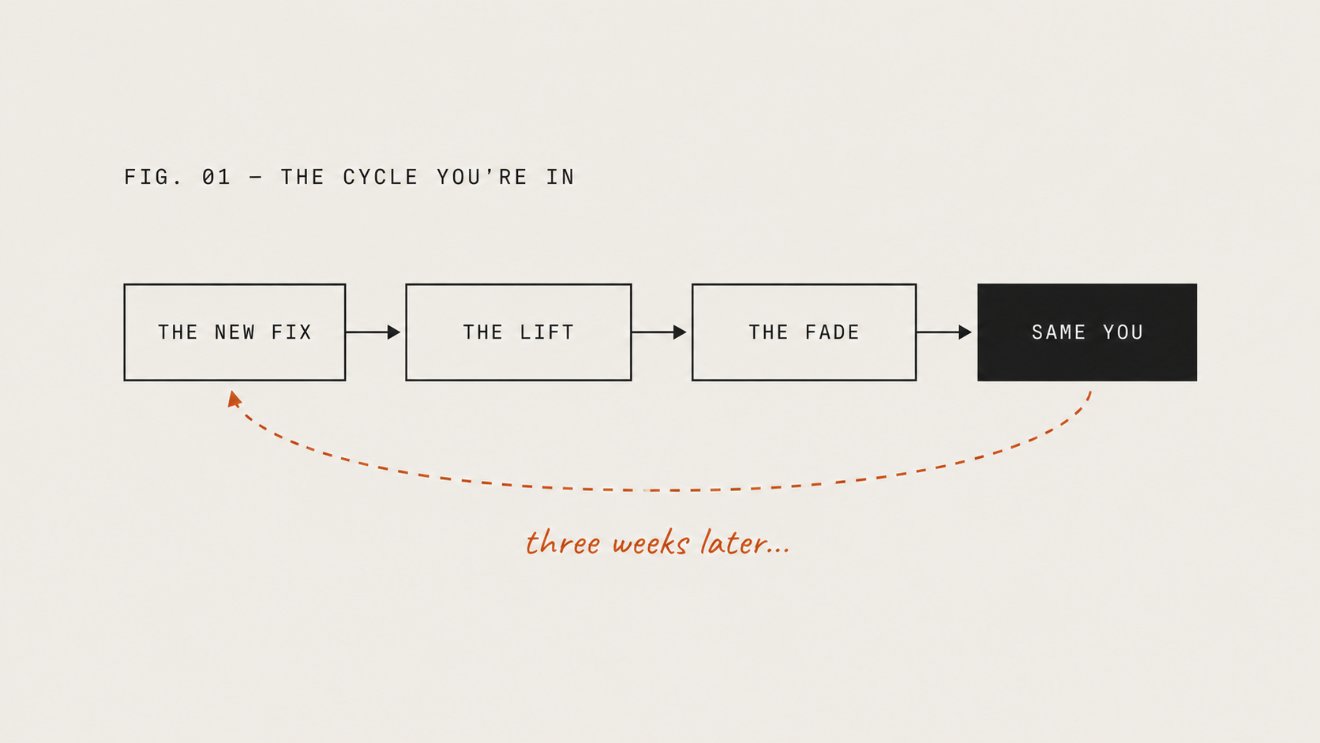
None of it failed. All of it was aimed at the wrong thing.
Right now a part of you is going: I’ve heard the root-cause thing before. Stay with me — this is where it gets specific.
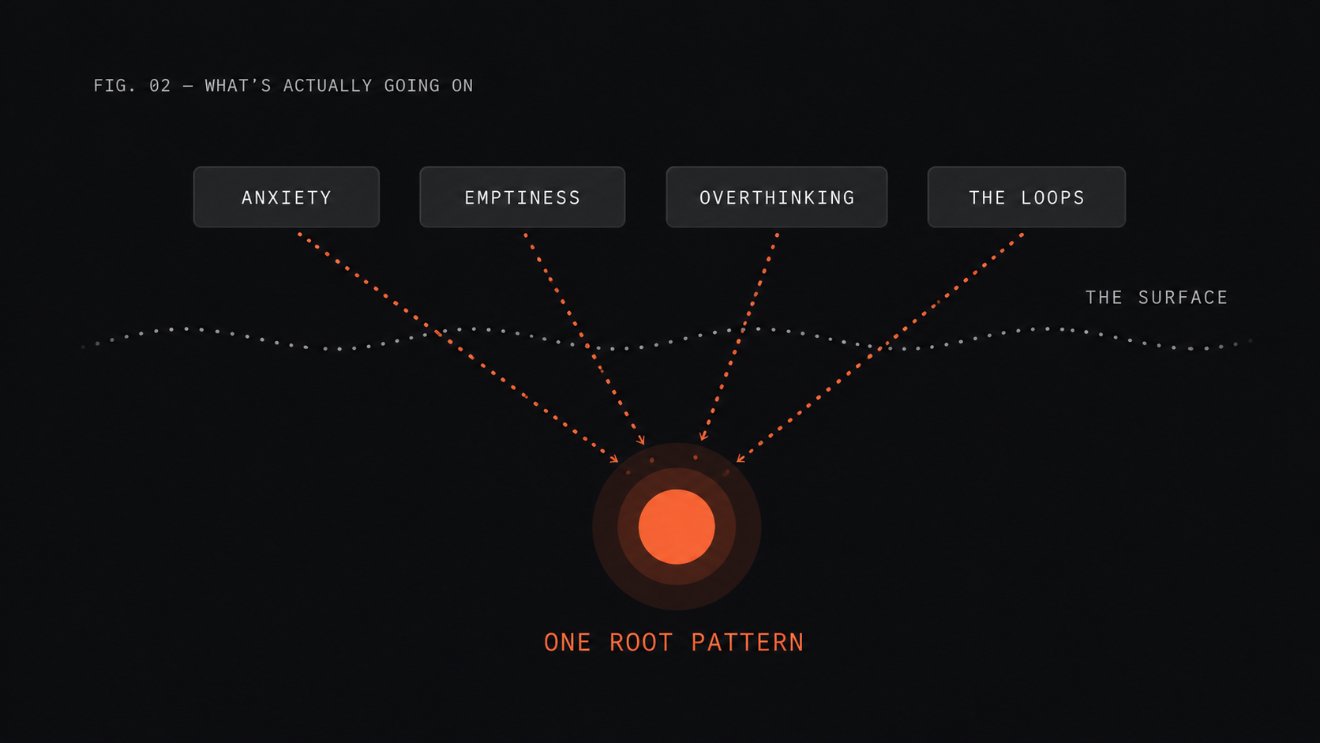
The stalled launch. The turnover. The plateau. The bottleneck that always ends up on your desk. You’ve been treating each one like its own problem — a hundred fires to put out.
They’re not fires.
They’re smoke.
Underneath them is one fire: your pattern — installed long before the company existed, and now running it. A company can’t grow past the pattern of the person at the top.
It hires in its own image.
It avoids the same conversations you avoid.
It even picked “work the strategy harder” as the fix — because strategy is the one suspect it knows you’ll never question.
Every fix you tried got stacked on top of that pattern.
That’s why the wall keeps coming back.
Consultants read the org chart. But the org chart is downstream of you. You’ve been renovating the company while the foundation walks into every meeting.
Now here’s the part I actually need you to hear.
Every time a fix faded, it filed another piece of evidence in the case you’ve been quietly building against yourself:
Maybe I’ve hit my ceiling.
Maybe I’m not built for this stage.
Maybe I should hand this to someone who is.
That case is wrong.
Every exhibit in it is smoke.
You’re not broken.
You’re patterned.
The pattern was a survival move.
It made perfect sense when it was installed — usually young, usually in a moment when it really was protecting you.
It just never got the message that the emergency ended.
So it’s still running, decades later, like it’s keeping you alive.
Nothing to fix. Nothing to fight.
A pattern you can see is a pattern you can choose around.
The whole problem is that you can’t see it.
You don’t need more strategy.
You need less.
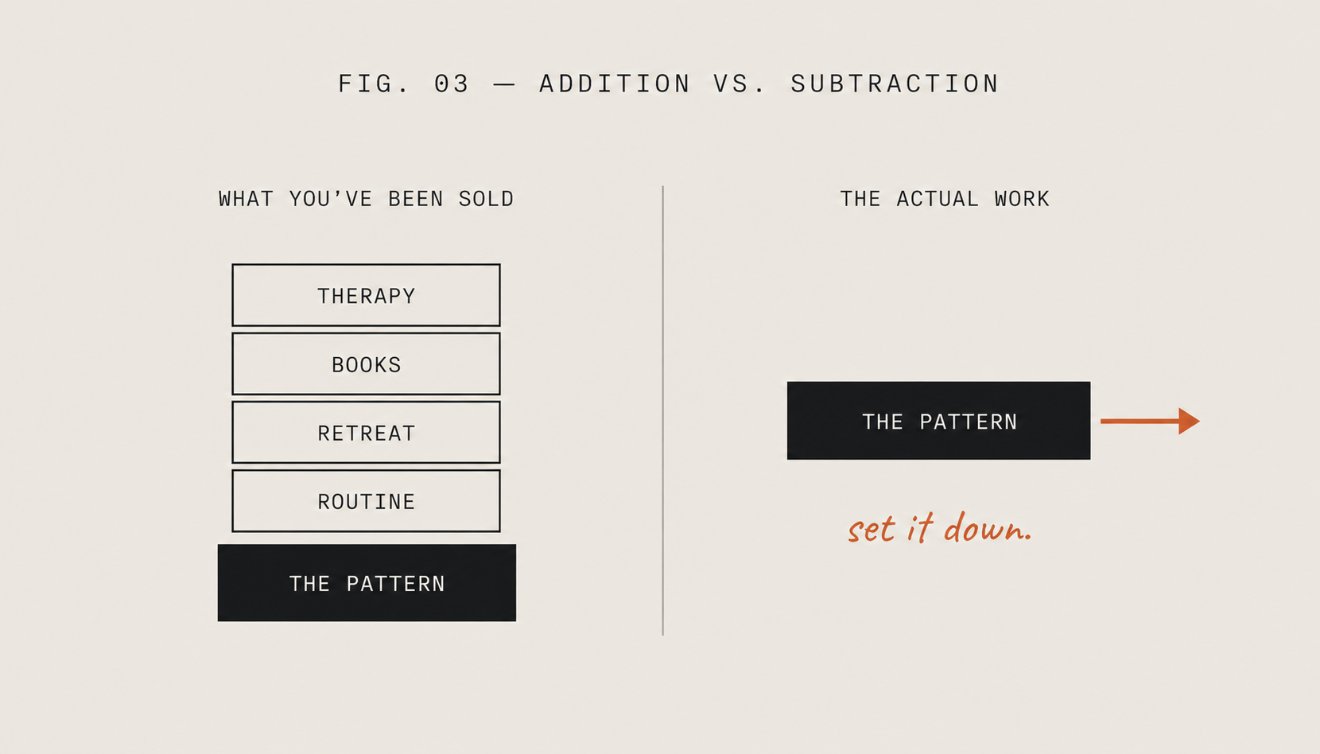
Everything you’ve tried so far was addition.
Add a framework. Add a hire. Add an advisor, a system, a sprint.
The whole industry is built on adding — because adding is what they can sell you next.
But you don’t plant a garden in an overgrown forest. You clear it first.
You were never missing something. You’ve been carrying something — one pattern that was never yours to keep.
The work isn’t adding tool number forty-one.
The work is finding the one thing to set down.
So why haven’t you found it yourself?
You can’t read the label from inside the jar.
You’ve lived inside this pattern so long it doesn’t look like a pattern.
It looks like your personality.
It looks like Tuesday.
It looks like “that’s just how I lead.”
This is the one job self-awareness can’t do alone. It’s why the most self-aware people are often the most stuck.
You don’t need more insight from inside the jar.
You need one accurate look from outside it.
One accurate look beats
ten more years of trying.
The Clarity Call. Thirty minutes. One accurate look.
You’re already wondering what actually happens on the call. Here it is, no mystery:
A live, recorded call.
No curriculum. No pitch. No homework.
I ask, you answer, and I follow what your answers — and your body — are actually saying:
Then I read your pattern back to you, out loud, in plain language — clear enough that you can’t unsee it.
After the call you get a written breakdown of your one root pattern, to keep.
“You’ve never heard of me. No book, no TED talk, no letters after my name — just four thousand-plus people who finally heard their pattern said out loud.”
I’m Chris Birky. Ten years of sitting across from people at the hardest moments of their lives taught me this work — watching what actually sets someone free, and what just keeps them busy. I’m trained in Logotherapy, Viktor Frankl’s work — meaning over symptom — and I’ve spent six years alongside the practitioners at Sedona Soul Adventures, the top transformational retreat in the country.
I read the body before the words, because the body doesn’t perform. And I’m not above any of this. Everything on this page, I lived first.

And now the question you won’t say out loud: what if he’s wrong about me? Fair. Here’s my answer.
If I miss, you lose thirty minutes.
And I owe you an hour.
You get the full session and the written breakdown first.
If what I name doesn’t land — if you don’t recognize yourself in it — I’ll give you another hour, on me, to find what I missed.
I don’t sell guaranteed breakthroughs.
I can only offer a deal this lopsided because after four thousand of these conversations, I don’t miss often.
You’re standing at a fork.
You close this page.
You hire the next consultant. The deck is great. It buys a quarter — then the wall comes back, and one more exhibit gets filed in the case against yourself.
A year from now: new org chart, same ceiling. And the company keeps paying for it with you.
You spend thirty minutes and nineteen dollars.
The pattern that’s been running your life gets a name. Said out loud, by someone outside the jar. You can’t unsee it after — and a pattern you can see is a pattern you can choose around.
Worst case, I’m wrong — you get your money back and a free hour. Best case, you find the wall — and it was never in the business.
P.S. Count what the wall has already cost the company — the launches, the people, the quarters. Now weigh that against thirty free minutes to find out where the wall actually is. If we’re not a fit, I’ll tell you straight and point you somewhere better.
P.P.S. You don’t know what you don’t know — until you know. Thirty minutes from now, you could know.